


)_20230830_134131_0000.png)


TO STEAM OR NOT TO STEAM?
All About Steaming
The two of us make no secret of our appreciation of food in its natural state, but that doesn't mean we don't partake in our own 'processing' of some of these beautiful raw ingredients. Do we eat cooked food? Yes. Are we fussy about the cooking methods we choose? Again, yes. We really prioritise steaming as it has so much in its favour, and the downsides are minimal.
Advantages of Steaming
Steaming can make certain foods easier to eat, or quite simply, edible in the case of the few foods that must be cooked to be consumed.
Nutrient loss with steaming tends to be minimal, typically less than most other cooking methods.
It's typically a fast way to prepare food, and in fact, the shorter the steaming time the greater the nutrient retention.
Because the maximum temperature achievable with steaming is well under 120°C, we can be confident that we're not creating any (known) cooked food toxins.
Disadvantages of Steaming
Some loss of vitamins, primarily water soluble vitamins ie B group vitamins and vitamin C. (Mineral loss is likely to be negligible).
Antioxidants do not withstand heat so these will mostly be lost.
Most enzymes do not survive temperatures above around 45°C. Some plant enzymes may assist with digestion, although that is still somewhat disputed. Others may catalyse beneficial transformations such as the enzyme myrosinase which transforms glucosinolates (powerful antioxidants) into isothiocyanates (even more powerful antioxidants!) This applies to cruciferous vegetables and accounts for their reputation for having anti-cancer properties. Chopping, blending, and chewing activate this enzyme, but cooking destroys it.
The following is a list of 12 vegetables that we enjoy steaming:
Broccoli - A lot of people find broccoli easier to eat steamed rather than raw. It’s a cruciferous vegetable so the note above about myrosinase applies here. On the plus side, the glucosinolates are still available in cooked broccoli and if cooking it means it’s more likely to be eaten, then there’s much more to gain than to lose by steaming it briefly.
Cauliflower - This is another cruciferous vegetable. Cauliflower works well steamed and raw. Eaten raw, it makes a good vegetable ‘rice’ when finely chopped. Steamed cauliflower allows for tender florets which are lovely as they are or as an ingredient in curries.
Carrot - Anyone who favours raw carrots will, at some time or another, almost certainly have found themselves engaged in a conversation about the beta carotene in carrots. Is this precursor to vitamin A more available in cooked carrots? Yes, it is. The vitamin C content, on the other hand, will be diminished, but who ever said it has to be one or the other? There are positives of each of them, so why not have the best of both worlds?
Kale - This cruciferous vegetable (yes, another one!) is easy to consume raw when blended into a smoothie, but eating it raw as a non-blended ingredient in a meal tends to be more challenging. Steaming kale transforms it, and the cooking time is typically short, making it a nutritious and ‘fast’ ingredient.
Kohlrabi - We recognise that this cruciferous vegetable is extremely common here in Germany, but it’s certainly available elsewhere and we believe it’s well worth trying to find one. It is very appealing whether eaten raw or steamed; maybe try a little bit raw before you put it in the steamer, and see for yourself which you prefer.
Leek - Most people find this onion family vegetable easier to eat cooked and steaming makes for a tender and flavour-full addition to a meal. Leeks can also be eaten raw; we recommend chopping it finely and using it as a seasoning for other vegetables.
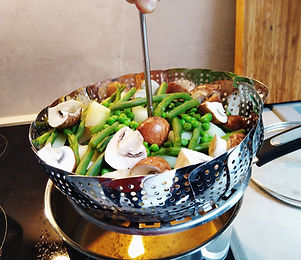
Mushroom - We’re surprised to find that few people have tried steamed mushrooms. If this is you and you like them, there’s a strong chance you’ll enjoy juicy, steamed mushrooms. Some people eat them raw, we mostly choose not to.
Onion - Steaming makes a big difference here by reducing the sometimes eye-watering sharpness of raw onions which isn’t to everyone’s taste. Steamed onions are sweet and tender.
Parsnip - Root vegetables such as parsnips and carrots lend themselves well to steaming. They take a little longer than some of the leafy or lighter weight vegetables, but they still classify as nutritious ‘fast’ food in our book, and in fact steamed parsnips could easily be turned into a soup with a reasonably good blender. If you’ve never tried raw parsnip, it makes a good vegetable ‘rice’ or ‘mash’, especially with a little bit of miso stirred into it.
Peas - If the peas are frozen, steaming them is quite simply a quick and easy way of thawing them and reheating them. They can be eaten uncooked (and fresh-from-the-pod peas are beautiful) but if they have been bought frozen then they have almost certainly been heat treated, i.e. blanched, so from a nutritional perspective, there’s nothing to gain by not steaming them.
Potato - Standard potatoes MUST be cooked to avoid potential toxicity. They can, of course, be boiled but cooking them alongside other vegetables in one receptacle (the steamer) saves some washing up later. The potatoes will need to go in first as the cooking time is longer than for most other vegetables.
Sweet Potatoes - Unlike their more traditional cousins (see above), sweet potatoes can be eaten raw but we choose to steam them and we recommend eating them this way.
A Few Ideas For Using Steamed Vegetables
Sometimes, time is of the essence and unnecessary washing up is undesirable, so one of our favourite things to do is to steam all the vegetables in one steamer and then add a suitable dressing or sauce. Our simple curry sauce works well here as does a tomato and paprika sauce that we enjoy making (and eating!)
Just because something is already cooked, doesn’t mean it can’t be briefly warmed up in the steamer with the vegetables. We often cook pre-soaked beans early in the morning and then just add them into the steamer with everything else if we want them warm.
And just because food is steamed, doesn’t mean it has to be eaten warm. We often combine steamed and raw vegetables to make a salad, some of them are warm and some we serve cold. This is a good and easy way to get a lot of taste, texture and nutrition.
And sometimes we steam just one item and serve it on a bed of leaves or other raw vegetables; “Miso Mushrooms” works well like this, the sauce of miso, lemon juice, garlic, tahini and flaxseed is a luxurious match for steamed mushrooms.
If you have any other ideas for steamed vegetables, we’d love to hear them!
There's a downloadable pdf version here.